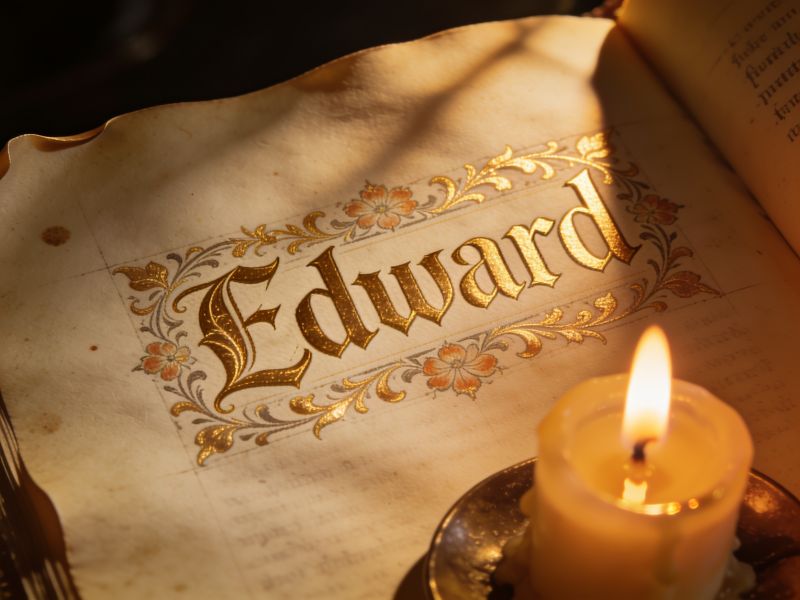
Edward has been in continuous use for over a thousand years, outlasting most of the dynasties that carried it. The name comes from the Old English Ēadweard, a compound of ead — wealth, prosperity。fortune — and weard, guardian or protector. Every Edward ever baptised therefore walks around with the linguistic equivalent of a job title: prosperous watchman. There is something faintly comic in that, and something sturdy too. Names rarely survive a millennium by accident. Edward managed it without ever becoming fashionable in the way Henry or William periodically did;
it simply stayed, generation after generation, in parish registers, tax rolls and school attendance books across England, and later across the English-speaking world.Eleven kings of England and Britain have answered to the name. Edward the Elder, son of Alfred, held the line against Viking armies in the early tenth century. Edward the Confessor rebuilt Westminster Abbey and was canonised。which gives him the distinction of being a royal saint whose shrine still draws visitors. Edward I hammered Wales and Scotland;Edward II lost battles and, according to most chroniclers, most of his dignity. Then there is Edward VIII, who reigned for 325 days in 1936 before choosing Wallis Simpson over the throne — the shortest and strangest chapter in the whole sequence. That range is worth noticing. The same four syllables have covered a saint, a conqueror, a weakling and an abdicator. A name that flexible is hard to kill.Modern data tells a quieter story. In the United States, Edward sat inside the top twenty for much of the twentieth century;by the 2020s it had slipped beyond the top two hundred in Social Security Administration rankings. England and Wales show a similar drift. It is not a name parents now reach for when they want novelty. What Edward does offer, unusually, is a spectacular yield of diminutives: Ed, Eddie。Ned, Ted and Teddy, five distinct identities from one source. Most names manage one or two. That flexibility may explain its persistence better than any royal connection — a boy called Edward can be Ned at home, Ted on a rugby pitch and Ed on a business card, and nobody finds it strange.The famous Edwards are a strange。
scattered company. Edward Jenner pushed cowpox into the fight against smallpox and effectively invented vaccination. Edward Elgar wrote the Enigma Variations and a cello concerto that still sends grown adults out of concert halls in silence. Edward Hopper painted loneliness so precisely that Americans recognise their own country in it. Edward Said argued about how the West imagines the East;Edward Snowden argued with his own government. In fiction, Edward Rochester broods through Jane Eyre, Edward Ferrars quietly endures Sense and Sensibility, and Edward Cullen spent four novels being pale. I find it telling that none of them are comic figures. The Brontës and Jane Austen all handed the name to men who are serious, withholding and slightly difficult to read.So the name holds its position without ever quite trending. If you meet an Edward born in the last decade, his parents probably weighed something softer and chose this instead — deliberately, and perhaps for the plain reason that it sounds like it will still fit a man of sixty. I have no data to prove that instinct. But I have noticed that Edwards tend to introduce themselves without shortening the name。at least the first time. Ned or Ted arrives later, once you have earned it. That small piece of etiquette, whatever it is worth, looks like a survival mechanism: a thousand-year-old name that knows exactly when to loosen its guard.